Gotland looks quiet until you look at what the sea makes possible.
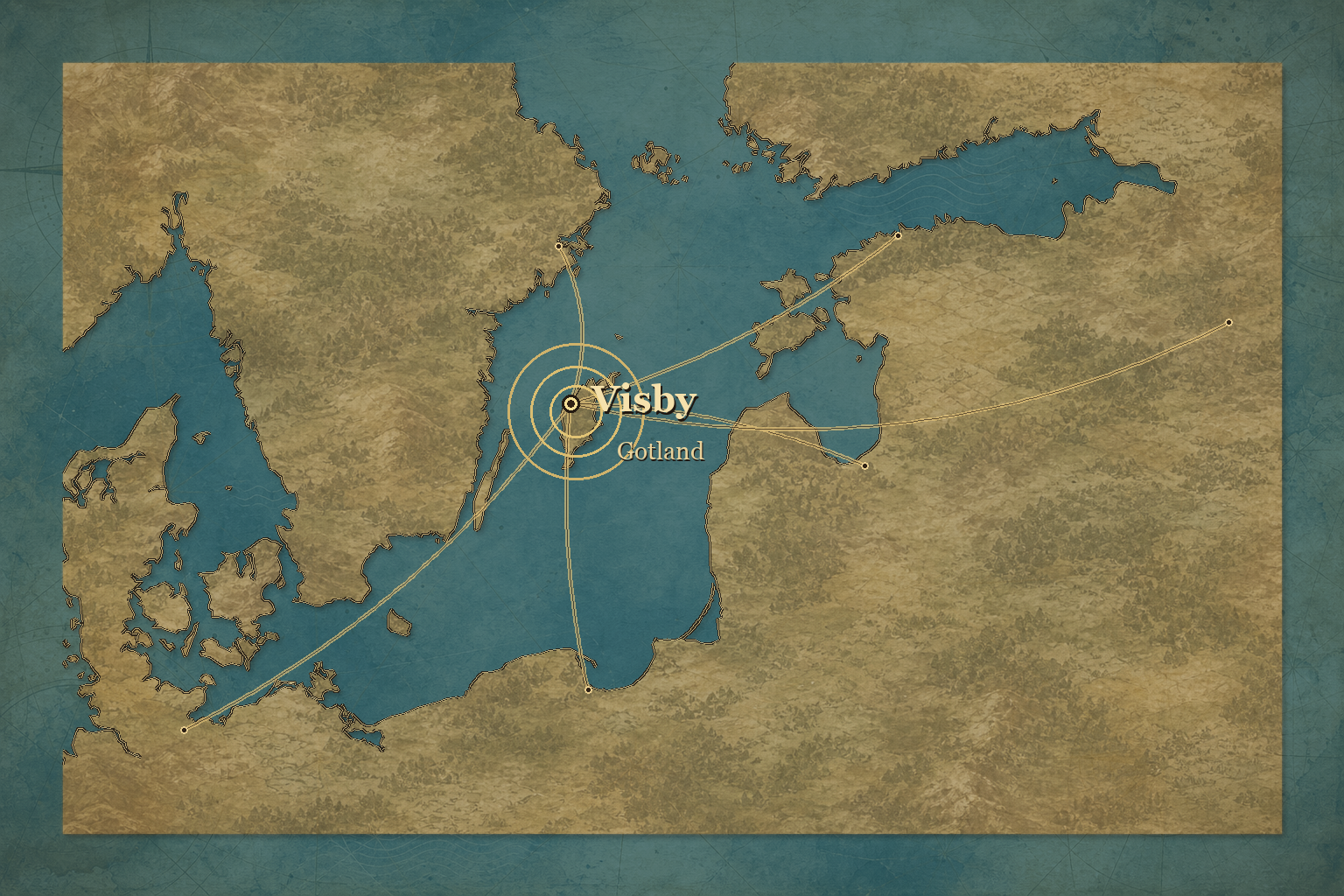
On a Baltic map, Gotland sits where the crossings tighten: east of the Swedish mainland, west of the Baltic coast, north of Poland and Germany, and within reach of routes toward Riga and Novgorod. Sweden’s entry into NATO on March 7, 2024, made that position visible again to modern readers. But strategic geography is older than modern alliances. In the Middle Ages, the same island position worked through harbors, merchants, warehouses, privileges, and cargo. Visby was not powerful because it ruled a large hinterland. It mattered because ships using the Baltic kept finding their way to its shore.
An island in the route
Ships crossing the Baltic did not see Gotland as a decorative island off Sweden. They saw a harbor on a hard crossing: a place to land, store goods, meet partners, exchange information, and wait for the next leg east or west. UNESCO describes Visby as a former Viking site on Gotland and as the main Hanseatic center in the Baltic from the twelfth to the fourteenth century. The city developed on a shore with a natural harbor, and Gotlandic merchants used it as a strategic point in Baltic trade.
That sequence matters. Visby was not simply a German city imported into the north. It stood on older Scandinavian and Gotlandic trading ground. Furs and wax came through eastern routes; timber, fish, grain, salt, cloth, amber, and other cargoes moved around the sea through contacts, risks, seasonal markets, and trusted places where merchants could meet. Visby became one of those places.
Before Lubeck
Lubeck deserves its reputation. It became the city most readers associate with Hanseatic leadership, Baltic access, and Low German merchant power. But if the Hansa story begins only at Lubeck, it becomes too tidy. Gotland and Visby belong to an earlier layer, when Baltic exchange was being pulled into towns, documents, privileges, and merchant associations.
European History Online’s synthesis of Hanseatic networks shows why. In the early 1160s, Henry the Lion mediated peace between Gotlanders and Germans. German merchants then operated within the Gotland association, and Visby became an important trans-shipment center between Scandinavia and the eastern Baltic. That does not make Visby the capital of the Hansa. It makes the city more interesting than that: one of the places where older Gotlandic exchange and newer Low German merchant organization overlapped.
Routes became stone
Visby’s value was not one famous export. It was the map around it: German merchants from the west, Scandinavian goods and seaborne contacts from the north, and eastern routes toward Novgorod, furs, wax, and other valuable cargoes. German merchants in Novgorod first lived in St. Olavshof, a court founded by Gotlanders, before opening the better-known Peterhof in the early thirteenth century. Visby also appears in the story of Riga, founded in 1201 with Visby’s backing according to the same Hanseatic network synthesis.
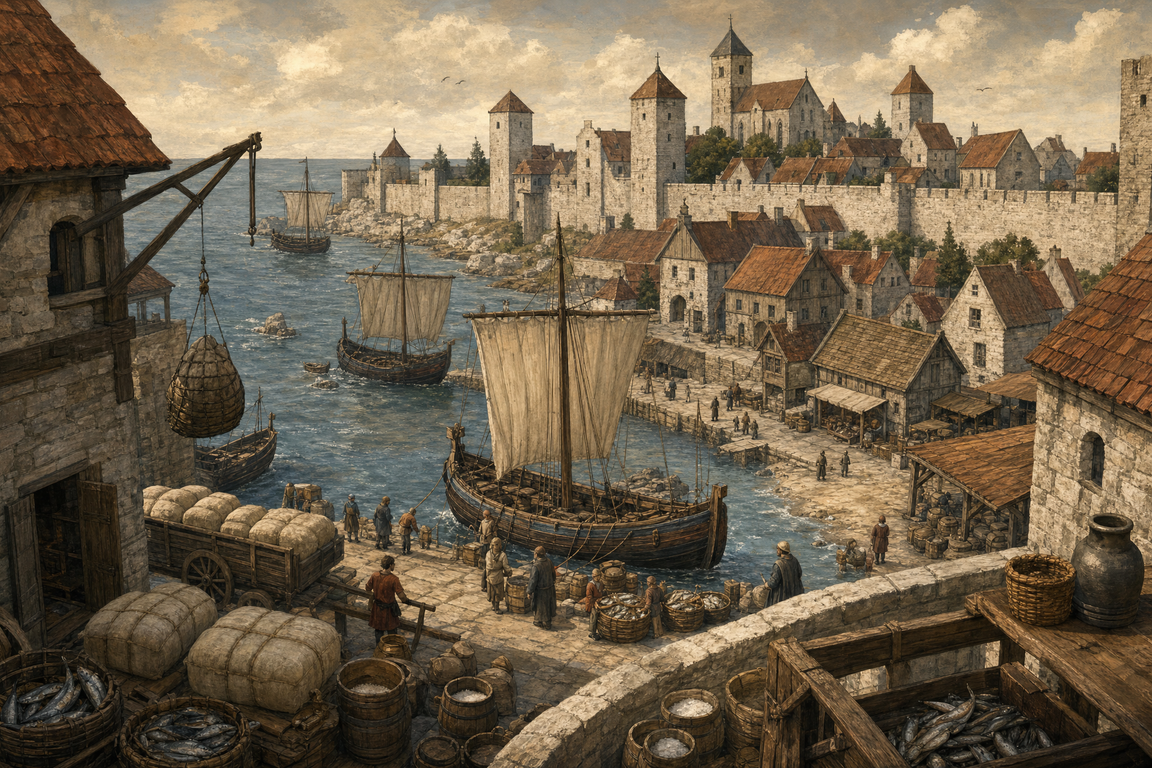
The easiest way to see that role is still physical. The city wall, ruined churches, street plan, warehouses, and merchants’ dwellings are not just scenery; they are trade routes turned into stone. UNESCO describes Visby as one of northern Europe’s best-preserved fortified commercial cities, with more than 200 warehouses and merchants’ dwellings inside the medieval town. The walls also keep the story from becoming too clean. Trade did not create harmony: Visby’s commercial rise sharpened divisions between the urban merchant community and rural Gotlanders, contributing to civil conflict in 1288.
Same island, different stakes
Visby’s medieval position did not last unchanged. The fourteenth century brought plague, war, piracy, and changing routes. In 1361, Valdemar Atterdag of Denmark invaded Gotland; later violence and decline included Lubeck’s attack in 1525. But decline should not swallow the story. What matters first is the rise of an island city that made Baltic crossings easier to organize, protect, store, and repeat.
For Hansa Trader, Visby teaches a different kind of city logic. The game may simplify that into goods, routes, prices, and city affinities. That is a design abstraction. Historically, Visby’s deeper identity was transit: a harbor, a warehouse city, a Gotlandic and German meeting point, and a link toward Novgorod and Riga. Gotland did not control the Baltic like an empire. It controlled possibility: shelter, storage, contacts, and access in the middle of a divided sea.
Sources
- NATO, “Sweden officially joins NATO”. Used for Sweden’s accession date and NATO membership context.
- Associated Press, “Thousands of NATO troops join drills in the strategically sensitive Baltic Sea region”. Used for the modern Gotland and Baltic security hook.
- UNESCO World Heritage Centre, “Hanseatic Town of Visby”. The main source for Visby’s harbor, Gotlandic merchant role, Hanseatic importance, warehouses, city wall, and later decline.
- Margrit Schulte Beerbuehl, “Networks of the Hanseatic League,” European History Online. The main synthesis for Gotlandic and German merchant networks, the early-1160s agreement, Visby as a trans-shipment center, Novgorod, and Riga.
- Hansisches Urkundenbuch I, Hansischer Geschichtsverein. Useful source-edition trail for Henry the Lion’s surviving charter on the German-Gotlandic peace.
Hansa Trader
Try your luck in a deep medieval trading game: run routes, build businesses, and grow your trading empire.
Further reading
- From Viking Trade Routes to the Hanseatic League. Background on the older northern trade routes that shaped the world Visby entered.
- Hanserecesse, Hansischer Geschichtsverein. Records and decisions of Hanseatic assemblies, especially useful for the more institutionally visible later Hansa.