If the best answer is always the same route, the same good, and the same repeated sale, the trading game is already over.
“Buy low, sell high” is a useful verb pair, but a thin fantasy on its own. The stronger fantasy is learning a place well enough to build a business inside it: spotting a shortage, committing cash and ship space, watching the market move, then deciding whether to double down or change course.
That is what separates a trading strategy game from a price table with ships. Scarcity, distance, information, production, timing, and rivals all have to matter together.
A Market Worth Reading
A market should invite a plan, then make that plan age.
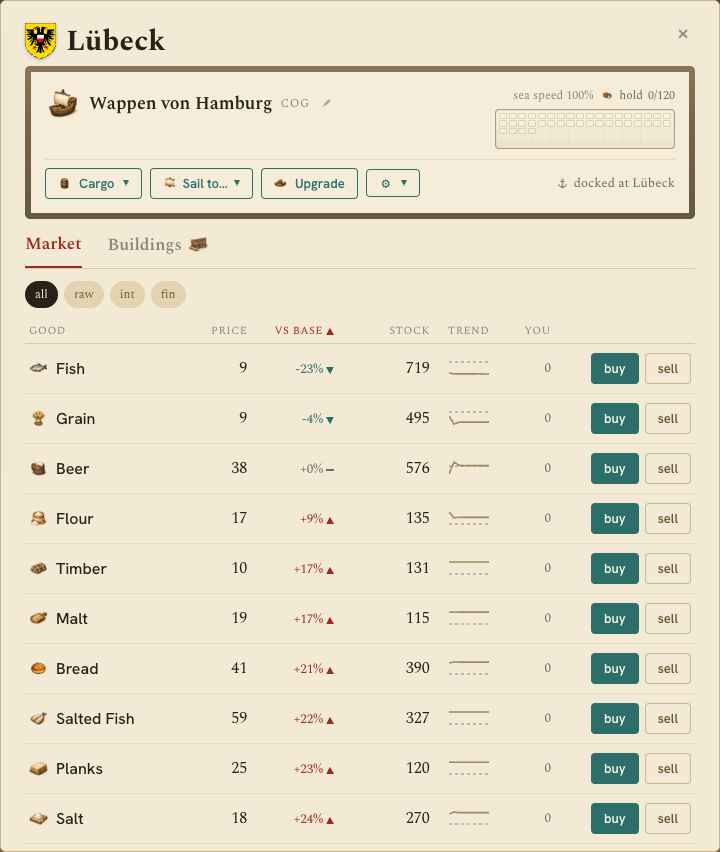
If Lubeck pays well for fish, the player should understand why. If they sell a full hold into that shortage, the price should not behave as if nothing happened. A small test sale and a market-flooding shipment are different decisions.
Static arbitrage wears thin because it turns discovery into routine. Once the player finds the permanent cheap city and the permanent expensive city, judgment gives way to repetition. Better designs are closer to M.U.L.E.’s auction pressure or Offworld Trading Company’s economic conflict: scarcity is visible, other actors respond, and price becomes part of the fight.
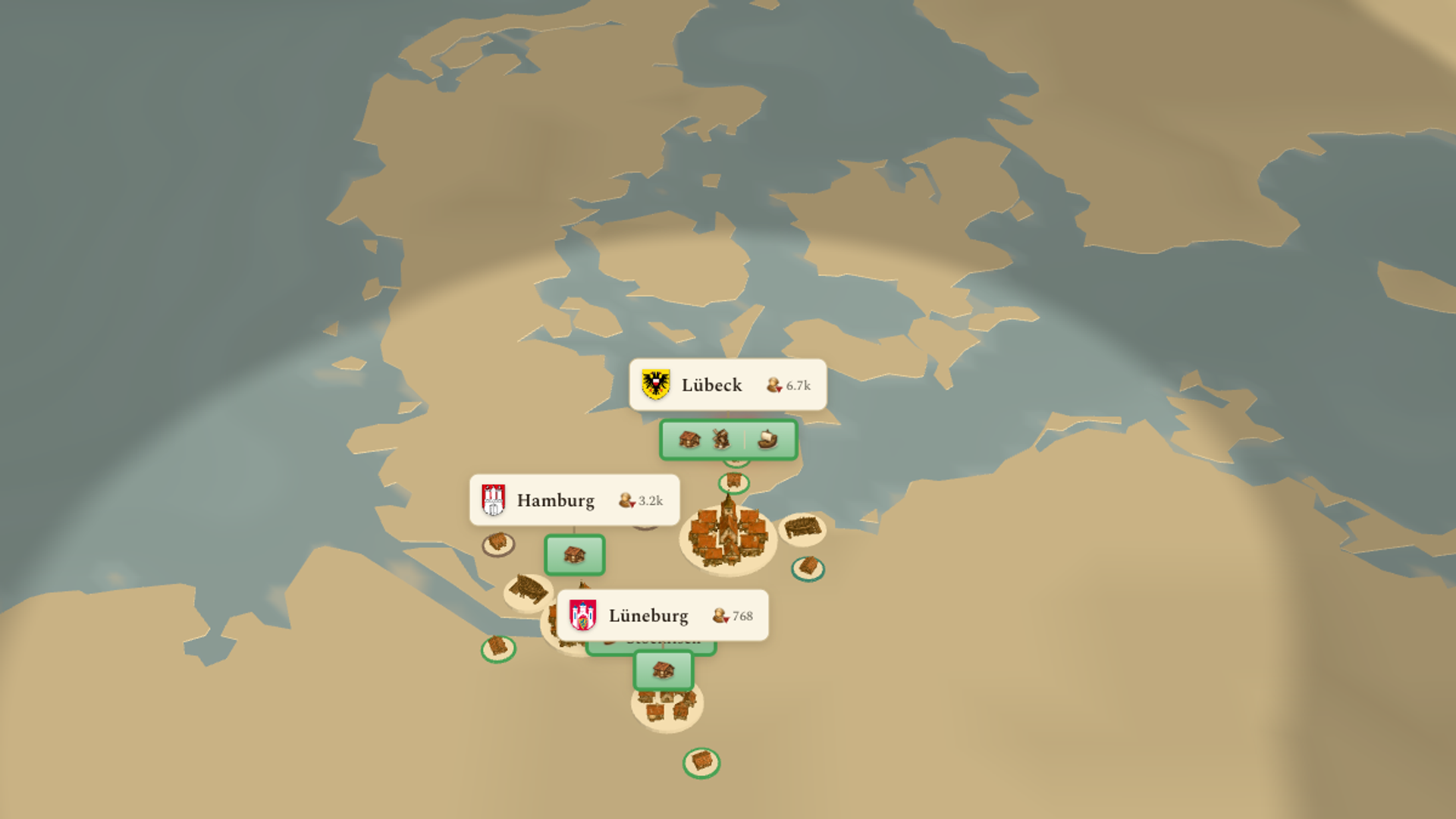
In Hansa Trader, each city market is shared by players, automated routes, AI Houses, and ambient convoys. The useful question is not only “is the spread positive?” It is “how much can I move before I ruin my own margin?”
Distance Must Create Value
Trade needs a journey. If movement has no cost, delay, or opportunity cost, the map is just decoration around an exchange screen.
Transport Tycoon made this point visually. Chris Sawyer described the appeal of a world where vehicles go about their business, and that remains the pleasure of logistics games: a plan becomes visible motion. A ship sent to Bergen cannot also be in Danzig. Hold space spent on grain is not available for salt. A price report may be stale by the time the cargo arrives.
Patrician and Port Royale work partly because cities are not interchangeable. Salt, fish, grain, cloth, timber, iron, wine, and luxuries belong to different places and demands. A route is interesting only when the world can push back: time passes, prices move, rivals arrive, and the ship has other work it could do.
Cargo Becomes A Business
At some point, a trading game has to stop asking only what to carry and start asking what to own.
Patrician IV’s official framing moves quickly from bargaining to production, fleets, political influence, price wars, sabotage, and piracy. Port Royale 4 similarly leans on production chains, cities, buildings, ships, and route optimization. The promise is not just a profitable voyage. It is a trading house becoming a network.
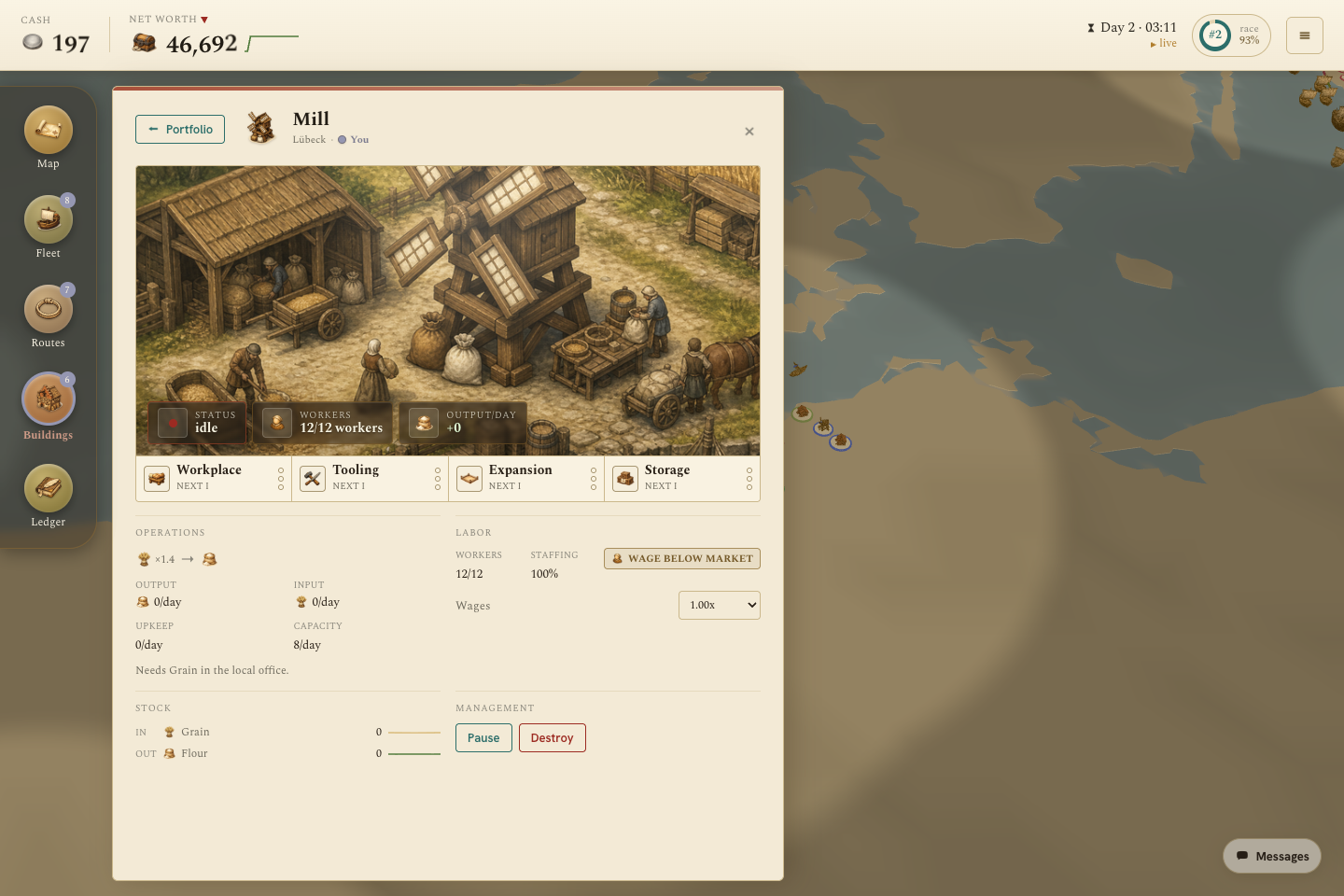
Production matters because it changes the question. A mill, bakery, warehouse, office, shipyard supply line, or contract turns “where is the margin?” into “what should I build around this margin?”
Owning the grain, flour, and bread chain can capture more value, but it locks cash, workers, and stock into one place. Buying flour stays flexible, but exposes the baker to shortages and other players’ prices. That make-or-buy tension is where a trading game starts to feel like a business game.
For business ownership, The Guild deserves special mention. Its best trick was making a shop feel lived-in: choose a trade, hire workers, buy inputs, sell output, climb city politics, and keep a family business alive. Hansa Trader does not need that much life-sim texture, but the lesson holds: ownership should create obligations, not passive income.
Rivals Make Markets Come Alive
Markets become stories when someone else can ruin a clean plan.
M.U.L.E. made that concrete through real-time auctions. Someone needs food. Someone else has a surplus. A player can hold out, overpay, punish a rival, or take a bad deal because the alternative is worse. Offworld Trading Company pushed the idea into real-time strategy without armies, letting the player-driven market carry the conflict.
A slower trade empire builder does not need to copy Offworld’s aggression. Often the better pressure is softer: undercutting, cornering supply, fulfilling a contract first, flooding a city with goods, or owning the intermediate product another player needs. Economic competition works when players can see levers, counters, and shared consequences.
Depth Has To Respect Time
Complexity is not depth by itself. A trading game can drown the player in price tables, cargo micromanagement, and route maintenance until the best strategy is simply having more patience than everyone else.
Automation helps only if it removes handling without removing decisions. A route should keep running after the player defines the logic. A business should keep producing if it has labor, cash, and inputs. The strategic work should be setup, adaptation, expansion, and timing, not repeating the same order forever.
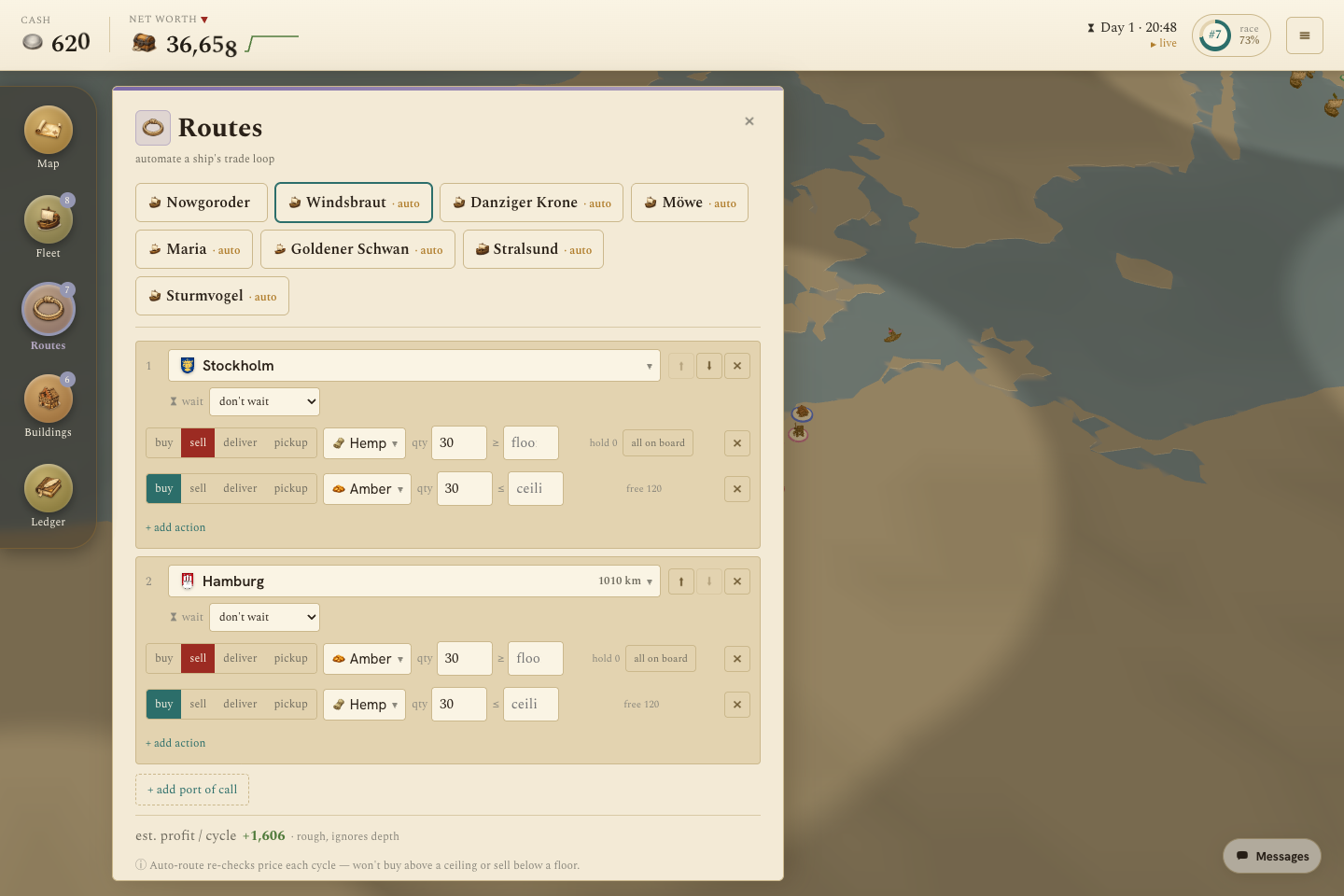
That is why Hansa Trader uses bounded, resumable trade worlds rather than a permanent always-on universe. Routes, buildings, and markets can advance, but the player still has a wealth goal and an ending. The same map can stay readable without producing the same opening every time.
The bet is simple: market mastery can carry drama normally supplied by conquest. A great trading strategy game leaves you thinking you understood the world a little earlier than your rivals, committed before the obvious move was obvious, and lived with the consequences when the market changed.
Sources
- James Hague, Halcyon Days, Danielle Berry interview. Used for M.U.L.E., real-time auctions, and Bunten Berry’s social game-design philosophy.
- Wired, “Enigmatic developer Chris Sawyer on remaking Transport Tycoon for mobile devices”. Used for Transport Tycoon and Sawyer’s logistics-world framing.
- Gaming Minds, Patrician IV. Used for the official Patrician IV framing around goods, production, fleets, influence, rivals, price wars, sabotage, and piracy.
- Gaming Minds, Port Royale 4. Used for the official Port Royale 4 framing around production chains, trade routes, cities, buildings, ships, and route optimization.
- PC Gamer, “The Guild series of medieval life choice simulators returns”. Used for The Guild series framing around business, family, professions, and city power.
- GDC Vault, “‘Offworld Trading Company’: An RTS Without Guns”. Used for the economics-instead-of-combat framing.
- Offworld Trading Company official site. Used for the player-driven market and economic competition framing.
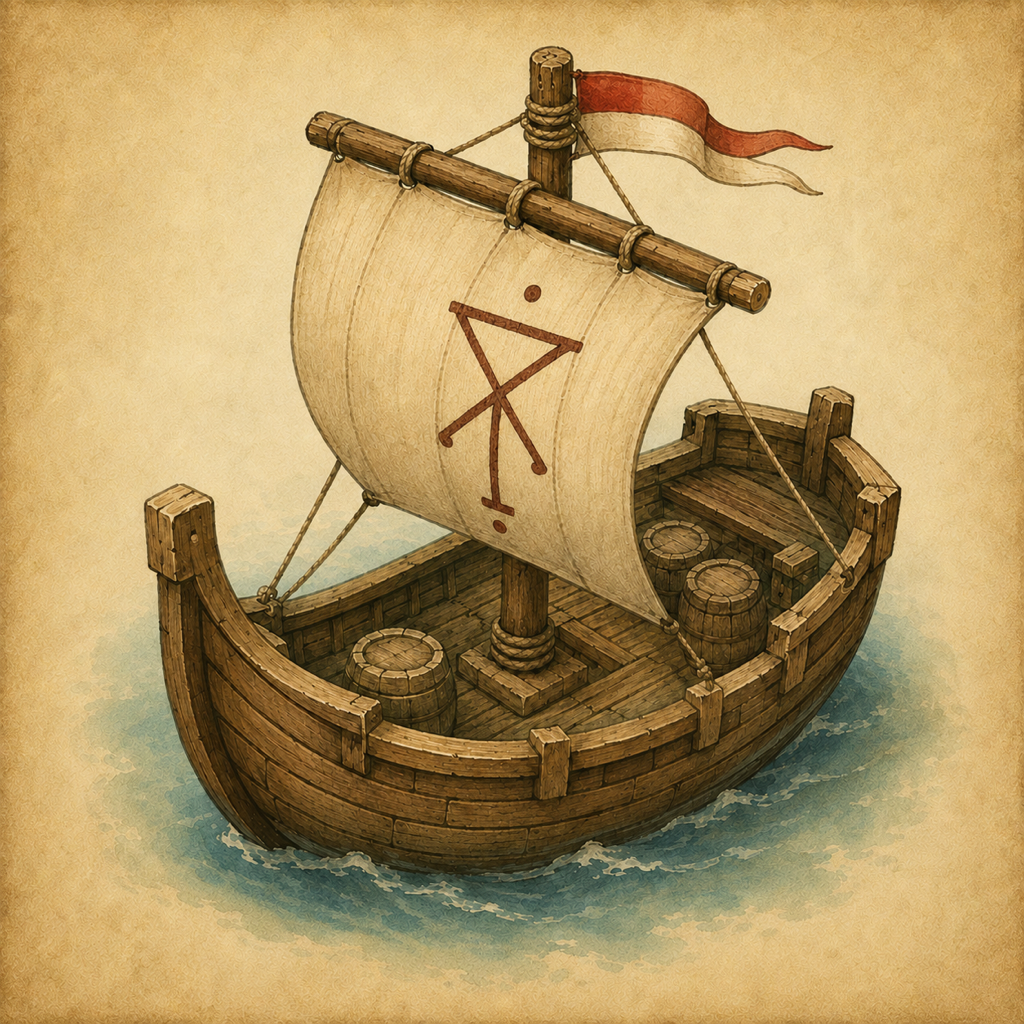
Hansa Trader
Try your luck in a deep medieval trading game: run routes, build businesses, and grow your trading empire.